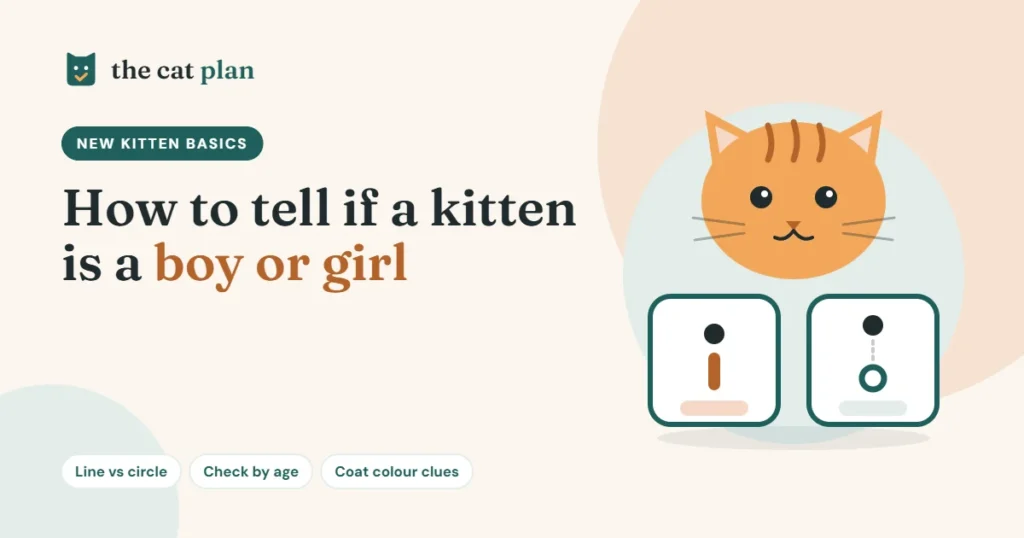
Gently lift the kitten’s tail and look at the two openings. A girl has a vertical slit right under the anus, so together they look like a letter "i". A boy has a small round opening about half an inch lower, with a furry gap where testicles appear from about 6 to 10 weeks.
- Female = line, male = circle: a slit close to the anus means girl; a round dot with a gap means boy.
- In young kittens the gap in males is about 1/2 inch; in adults it is more than 1 inch.
- Sexing is easier after about 8 weeks; testicles show at around 6 to 10 weeks.
- Calico and tortoiseshell cats are almost always female; about 80% of orange cats are male.
- Keep newborns warm and checks short: kittens under 3 weeks cannot control their body temperature.
- If you cannot feel a male’s testicles by 2 to 4 months, talk to your vet.
- Ask your vet to confirm sex at the first visit and plan spay or neuter by about 5 months.
Telling whether a kitten is a boy or a girl is surprisingly tricky, especially in the first few weeks. Even experienced fosters get it wrong sometimes. The good news: there’s a simple check that works at any age, and it only takes a few seconds.
This guide pulls together advice from shelter and veterinary sources, including HumanePro, International Cat Care, VCA Animal Hospitals and the MSD Veterinary Manual. You’ll learn the line-vs-circle method, what changes as your kitten grows, which coat colours give real clues, and when to let your vet decide.
The short version: line vs circle
Every guide from shelters and vet charities boils down to the same two checks: the shape of the opening under the anus, and how far apart the two openings are.
- Girl: the genital opening is a short vertical slit that sits right under the anus. Together they look like a lower-case letter “i” (International Cat Care), or “a dot and a line” (Kitten Lady).
- Boy: the genital opening is a small round dot, set further down. In young kittens the gap is about 1/2 inch, and that gap is where the scrotum and testicles form (HumanePro, Humane World for Animals). Together they look like two dots, or a colon with a wide space.
Kitten Lady’s mnemonic is the easiest to remember: female = line, male = circle.
| Check | Girl kitten | Boy kitten |
|---|---|---|
| Shape of genital opening | Vertical slit or teardrop | Small round dot |
| Distance from anus | Very close, almost touching | About 1/2 inch in kittens; more than 1 inch in adults |
| Letter it looks like | “i” (dot above a line) | “:” with a gap (two dots) |
| Area between openings | Little or no fur gap | Furry gap where the scrotum develops |
| Feel (from ~6–10 weeks) | Nothing to feel | Two small firm ovals (testicles) |
Adult figures come from the Alley Cat Allies cat identification guide: less than 1/2 inch in females, more than 1 inch in males, neutered or not.
Before you start: how to hold a kitten safely
Checking takes about 30 seconds. The goal is to keep the kitten calm, warm and supported the whole time.
- Wash and warm your hands. Cold hands make kittens squirm, and very young kittens lose heat fast.
- Pick a warm, quiet spot. Lay a soft towel on your lap or a table. Daily Paws suggests laying the kitten on a towel rather than holding it in the air (Daily Paws).
- Support the body. Let the kitten rest on its tummy or lean back against your hand, with all four feet supported.
- Lift the tail gently from the base. Never lift or pull a kitten by its tail.
- Look, don’t poke. You only need a few seconds of looking. Gently part the fur if needed.
- Put the kitten back quickly. PetMD advises not keeping kittens under 8 weeks away from mom and littermates for more than about 5 minutes (PetMD).
Newborns need extra care. Kittens cannot control their own body temperature until they are at least 3 weeks old, and getting chilled can be life-threatening (Alley Cat Allies). Keep checks very short and keep the kitten on a warm surface. If a newborn feels cool, warm it before anything else. Our newborn kitten guide covers safe warming.
How much should your kitten eat?Get daily calories, portions and a feeding schedule for your kitten’s exact age and weight.
Step by step: how to tell if a kitten is a boy or girl
- Find the anus. It’s the first opening right under the tail.
- Look below it. The second opening is either the vulva (girl) or the prepuce, the opening that covers the penis (boy) (HumanePro).
- Check the shape. A slit or line means girl. A round dot means boy.
- Check the gap. Openings that almost touch mean girl. A clear gap of fur, about 1/2 inch in a young kitten, means boy.
- Feel gently (older kittens only). From roughly 6–10 weeks, you can softly feel the area between the openings with a thumb and finger. Two small ovals means a boy (HumanePro).
- Compare littermates. If you have a litter, look at two or three kittens side by side. The differences in spacing stand out much more when you compare (ASPCApro).
- Write it down, and ask your vet to confirm. Note your best guess and get it checked at the first vet visit.
Identifying a girl kitten (female)
A female kitten’s two openings sit very close together. The anus is a small round opening and the vulva just below it is a short vertical slit, so the pair looks like an upside-down exclamation mark or a letter “i” (International Cat Care).
Signs that point to a girl
- A slit, not a dot, under the anus.
- Almost no space between the two openings.
- No small bumps to feel between them, even after 8–10 weeks.
- A calico or tortoiseshell coat (a strong clue; see the coat colour section).
One caution from PetMD: small or missing testicles don’t prove a kitten is a girl. A rescued older kitten may already be neutered, and young males’ testicles can be hard to feel (PetMD).
Identifying a boy kitten (male)
A male kitten’s genital opening is round and sits further down. The fur-covered space between the anus and that opening is where the scrotum forms, so it gets more obvious each week (HumanePro).
Signs that point to a boy
- A small round dot, not a slit.
- A clear gap, about 1/2 inch in kittens, between the two openings.
- A slightly raised, furry area in that gap.
- From about 6–10 weeks, two small firm ovals you can see or feel.
- An orange (ginger) coat makes “boy” more likely, but not certain.
The shape of the opening matters more than the gap in very young kittens, because all the distances are tiny at that size.
Boy or girl by age: what you can see at each stage
Sexing gets easier as kittens grow. International Cat Care says it’s easier after about 8 weeks, though possible before (iCatCare). Not sure of your kitten’s age? Use our kitten age chart first.
| Age | How easy? | What to rely on |
|---|---|---|
| 0–2 weeks | Hard | Shape (line vs dot) and comparing littermates. Keep checks very short; warmth first. |
| 3–5 weeks | Getting easier | Shape plus spacing. The gap in males is starting to show. |
| 6–10 weeks | Fairly easy | Spacing is clear; testicles may become visible or palpable (HumanePro). |
| 8 weeks+ | Easier for most people | All three cues: shape, gap and testicles (iCatCare). |
| 2–4 months | Easy | Testicles should usually be in the scrotum by 2 months. If you can’t feel them by 2–4 months, ask your vet (VCA). |
| 4–6 months+ | Easy, plus behaviour | Puberty signs (heat, spraying) can appear. Spay or neuter is usually advised by 5 months (AVMA). |
When do a male kitten’s testicles appear?
According to HumanePro, testicles aren’t plainly visible until about 6–10 weeks (HumanePro). VCA Animal Hospitals says they usually descend into the scrotum by 2 months and rarely after 6 months (VCA).
What if you can’t find them?
A testicle that doesn’t drop is called a retained testicle, or cryptorchidism. VCA says:
- It affects fewer than 2% of cats, and usually only one testicle is retained.
- It seems to be inherited and may be more common in Persians, Himalayans and Ragdolls.
- A vet becomes suspicious if testicles still can’t be felt at 2–4 months.
- A retained testicle still makes testosterone, so spraying and tomcat behaviour can continue. It can also twist or develop a tumour, which is why vets remove it during neutering (VCA).
If your “girl” kitten starts spraying or acting like a tomcat, or your boy has only one testicle you can feel, talk to your vet. They can check, and plan the neuter around it.
Can coat colour tell you a kitten’s sex?
Sometimes, yes. The main orange/black colour gene in cats sits on the X chromosome, so coat colour is linked to sex.
| Coat | Likely sex | Why |
|---|---|---|
| Calico (white, orange and black) | Almost always female | Needs one X with orange and one with black (MSD Veterinary Manual) |
| Tortoiseshell (orange and black) | Almost always female | Same X-linked genetics (MSD Veterinary Manual) |
| Orange / ginger tabby | Usually male | About 80% of orange cats are male (Alley Cat Allies) |
| Black, grey, white, tabby, pointed | No clue | Not sex-linked; check the openings instead |
Male calicos exist, but they’re rare
The MSD Veterinary Manual describes male calico and tortoiseshell cats as very rare. They usually carry an extra X chromosome (XXY) and are sterile (MSD). The Merck Veterinary Manual also lists chimera patterns, where the cat has a mix of cell types, and notes these males are sterile too (Merck). You’ll see “1 in 3,000” quoted online, but we couldn’t find a primary source for that number, so treat it as folklore.
Bottom line: coat colour is a hint. Always check the openings too.
Do body shape or behaviour show a kitten’s sex?
Not reliably in young kittens. Before puberty, boys and girls look and act much the same.
- Size: adult intact males often grow larger, with broader heads and jaws (Alley Cat Allies), but kittens of the same age overlap a lot. Track growth with our kitten weight chart rather than guessing sex from size.
- Personality: Best Friends Animal Society says there is no strong scientific evidence that sex predicts a cat’s personality. Early socialisation, health and environment matter more (Best Friends). Hill’s adds that most sex differences show up in cats that haven’t been spayed or neutered (Hill’s Pet Nutrition).
Puberty signs (from about 4–6 months)
Behaviour gets more telling once kittens reach puberty, which can be as early as 4–5 months (AVMA).
| Girl (in heat) | Boy (intact) |
|---|---|
| First heat on average around 6 months (VCA) | Urine spraying and strong-smelling urine (VCA) |
| Rolling, rubbing, kneading with back feet | Roaming and trying to get outside |
| Loud yowling, raised hindquarters (Merck) | Fighting with other males |
| Heats last about a week and can return every ~3 weeks in season (VCA) | “Stud tail” (greasy base of tail) |
Don’t wait for these signs to find out. A female can get pregnant during her first heat, so get your kitten checked and booked in for spay or neuter early.
How to tell if an adult or rescued cat is already fixed
If you’ve taken in an older kitten or a stray, you may want to know whether it has already been spayed or neutered.
- Ear tip: a straight cut across the tip of the left ear is the universal sign that a community cat was spayed or neutered (and usually vaccinated) through a TNR program (Alley Cat Allies).
- Green tattoo: many shelters and clinics put a small green line tattoo near the spay incision site on both females and males, because neutered males can be mistaken for females (ASPCApro / ASNA).
- Scar: a spayed female may have a small scar on the belly, but fur often hides it (Alley Cat Allies).
- No testicles: in an adult with male spacing, this usually means neutered, but a retained testicle is possible (VCA).
A vet can confirm with a check or, when needed, a simple test.
Common mistakes when sexing kittens
| Mistake | Why it happens | Fix |
|---|---|---|
| Calling a boy a girl in the first weeks | Testicles aren’t visible yet | Judge by shape and gap; re-check at 8–10 weeks |
| Calling a fluffy kitten a girl | Long fur hides the gap | Dampen or part the fur gently; compare littermates |
| Trusting coat colour alone | Only calico, tortie and orange carry real clues | Always check the openings |
| Assuming no testicles means female | Cat may be neutered or have a retained testicle | Look at spacing; ask your vet |
| Holding a newborn too long | Wanting to be sure | Keep it to seconds; try again another day |
Mix-ups are common enough that PetMD notes stories of a “Max” who turns out to be a “Maxine” abound (PetMD). Pick a name you’d be happy to keep either way, or wait until after the first vet visit.
Why knowing your kitten’s sex matters
As Kitten Lady points out, sex doesn’t change how you raise or feed a kitten (Kitten Lady). Calories, portions and the kitten feeding schedule depend on age and weight, not sex. Where it does matter:
- Spay or neuter planning. The Feline Fix by Five campaign recommends spay or neuter by 5 months. It’s endorsed by the AVMA, AAFP, AAHA, the Association of Shelter Veterinarians, CFA and TICA (AVMA). Your vet will set the exact timing.
- Keeping littermates apart. Brothers and sisters can mate once they reach puberty, so separate unfixed opposite-sex kittens or fix them early.
- Health checks. Spaying before the first heat greatly lowers mammary tumour risk, and neutering early helps prevent spraying (AVMA; VCA).
- Records and microchip details. Correct sex helps vets, shelters and lost-pet databases match your cat.
For the rest of the first year, from vaccines to teething, see our kitten timeline and the 2–6 months guide.
When to ask your vet
Ask your vet to confirm your kitten’s sex at the first check-up. It takes them seconds. Also talk to your vet if:
- you can’t feel testicles in a male by 2–4 months (VCA);
- a kitten’s genitals look swollen, red, or have discharge;
- a kitten is straining, crying when peeing, or has a wet or dirty bottom;
- a kitten you thought was female starts spraying, or a “male” goes into heat;
- you’re caring for newborns and aren’t sure they’re feeding and staying warm.
Getting ready for that first visit? Our new kitten checklist lists what to have at home.
Frequently asked questions
How can you tell if a kitten is a boy or girl?
Lift the tail gently and look at the two openings. A girl has a vertical slit right under the anus, like a letter "i". A boy has a small round opening about 1/2 inch lower, with a furry gap where the testicles develop. Ask your vet to confirm at the first visit.
How can I identify a male kitten?
A male kitten has a round genital opening set clearly below the anus, about 1/2 inch apart in young kittens. From about 6 to 10 weeks you may see or gently feel two small ovals between the openings. Orange kittens are more often male, but always check the openings.
How can I tell if my 3-week-old kitten is a boy or girl?
At 3 weeks, rely on shape: a slit means girl and a round dot means boy. Comparing littermates side by side helps most. Keep the kitten warm and the check very short, because kittens this young cannot fully regulate their body temperature. Re-check at 8 to 10 weeks.
At what age can you tell a kitten’s sex?
You can often tell from birth by the shape of the openings, but it is easier after about 8 weeks. Testicles usually become visible or palpable at around 6 to 10 weeks and should be in the scrotum by about 2 months.
Are calico kittens always female?
Almost always. The orange and black colour genes sit on the X chromosome, so a cat usually needs two X chromosomes to be calico or tortoiseshell. Male calicos are very rare, usually carry an extra X chromosome (XXY) and are usually sterile.
Are orange kittens always male?
No, but most are. Alley Cat Allies estimates about 80 percent of orange cats are male. Orange females exist, so check the openings to be sure.
Is a girl or boy kitten friendlier?
There is no strong evidence that sex predicts personality. Best Friends Animal Society says early socialisation, health and environment matter more. Most behaviour differences show in cats that are not spayed or neutered, and spay or neuter by about 5 months is widely recommended.
What if I cannot find my male kitten’s testicles?
Testicles usually descend by 2 months. If you still cannot feel them at 2 to 4 months, talk to your vet. A retained testicle (cryptorchidism) affects fewer than 2 percent of cats and is removed during neutering because it can still cause spraying and other problems.
Sources
- HumanePro (Humane World for Animals): Fact sheet: How to determine a kitten’s sex
- HumanePro: Sexing kittens fact sheet (PDF)
- International Cat Care: How to tell the sex of a kitten
- Kitten Lady: Determining a kitten’s sex
- ASPCApro: Kitten sexing job aid
- Alley Cat Allies: Cat identification guide
- Alley Cat Allies: Caring for neonatal kittens
- VCA Animal Hospitals: Retained testicle (cryptorchidism) in cats
- MSD Veterinary Manual: Calico and black and orange tortoiseshell cats
- Merck Veterinary Manual: Intersex conditions of animals
- VCA Animal Hospitals: How to tell if your kitten is in heat
- Merck Veterinary Manual: Management of reproduction of cats
- AVMA (JAVMA News): Fix by Five campaign aims to reduce cat overpopulation
- VCA Animal Hospitals: Cat neutering and behavior
- Alley Cat Allies: Feral cat protocol: eartipping
- ASPCApro / ASNA: Identifying sterilized animals (PDF)
- Best Friends Animal Society: Male vs. female cat personality
- Hill’s Pet Nutrition: Differences between male and female cats
- PetMD: How to determine the sex of a kitten
- Daily Paws: How to determine the gender of a kitten